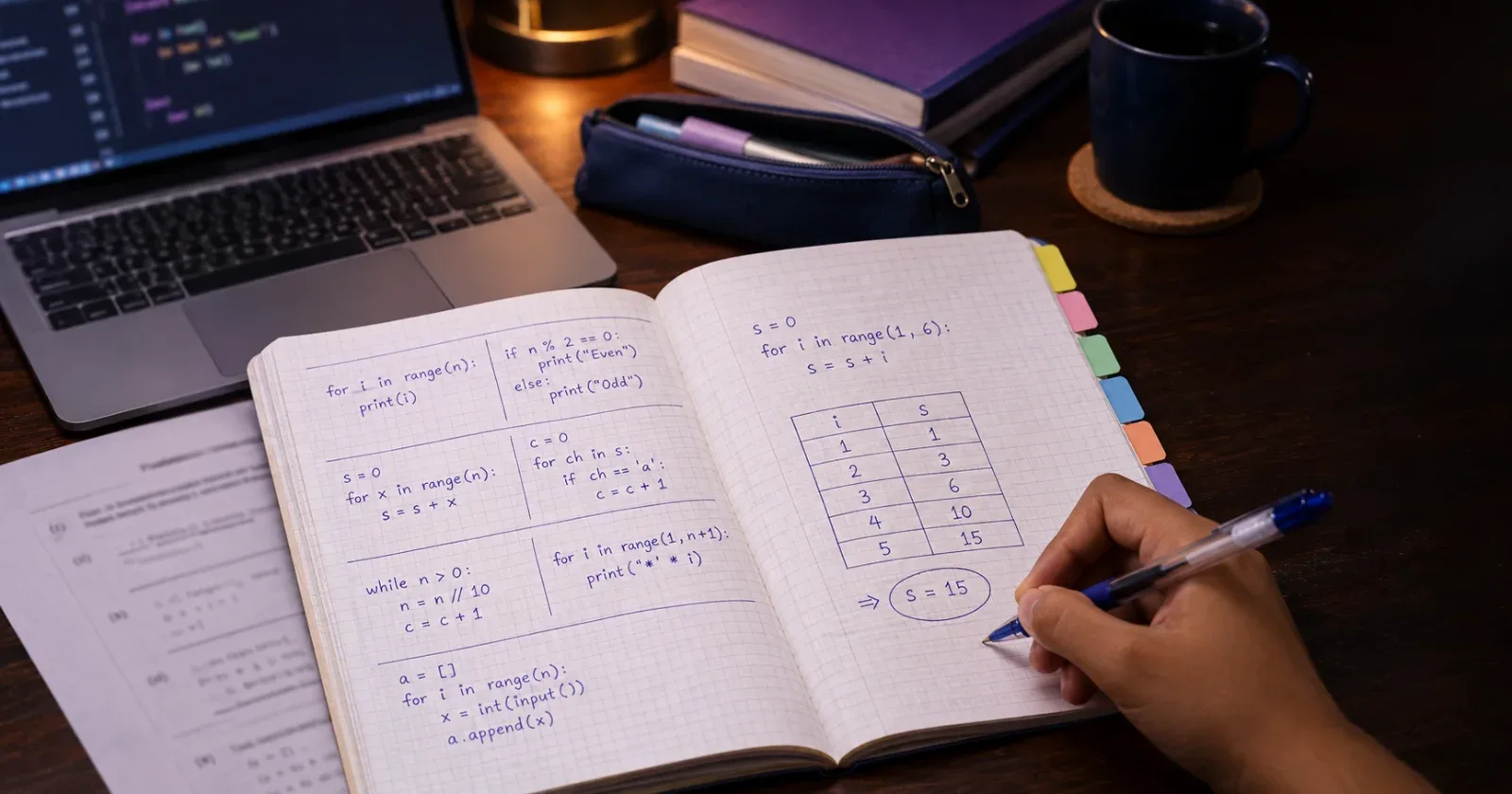
Paper I tests how widely you know the syllabus. A/L ICT Paper II tests how deeply you understand it and how clearly you can show that understanding. Many capable students lose marks here not because they don't know the answer, but because of how they present it or how they use their time. This guide shows you how the paper works and how to answer it well.
How A/L ICT Paper II is set out
Paper II is three hours long, with ten minutes of additional reading time before you start writing. It has two parts:
- Part A — Structured questions: four questions, and you answer all of them on the question paper itself. The paper tells you that the space provided is enough and that extensive answers are not expected.
- Part B — Essay questions: six questions, and you answer any four on separate answer paper.
Calculators are not allowed. At the end, Part A and Part B are tied together and handed in; you may keep only the Part B question pages.
Use the ten minutes of reading time well
The reading time is not a rest. Use it to do three things:
- Read all six Part B questions and choose your four. Pick questions where you can answer every sub-part, not just the first one.
- Decide your order. Start Part B with your strongest question to build confidence and save time.
- Note quick ideas for any question that needs a diagram, a table or code, so you can start writing immediately.
Tip: A Part B question that looks long is not necessarily difficult. Long questions often contain a detailed scenario that actually makes the sub-parts easier to answer.
A timing plan for three hours
There is no single correct split, but you need a plan before you walk in. Many students find this works well:
| Section | Suggested time |
|---|---|
| Part A (4 structured questions) | about 70 minutes (around 17 minutes each) |
| Part B (4 essay questions) | about 100 minutes (around 25 minutes each) |
| Final check | about 10 minutes |
Test this split on two or three full past papers and adjust it to your own speed. The key is to move on when your time for a question is up, and come back later if you have time left. An unfinished fourth essay costs far more marks than a slightly shorter third one.
What the marking scheme rewards
Study a few marking schemes from our past papers page and you will notice a pattern: marks are attached to specific points, steps and features. To earn them:
- Answer exactly what is asked. "State" needs a short point. "Explain" needs a reason. "Compare" needs both sides.
- Give the number of points requested. If the question asks for two advantages, give two clear, different ones.
- Show your working in calculations such as number conversions and subnetting. A correct method can earn marks even if the final answer slips.
- Use correct technical terms. "Primary key", "broadcast address" and "iteration" are clearer than everyday words.
- Label diagrams fully. ER diagrams need entity names, attributes, keys and relationship types. Network diagrams need devices and connections labelled.
A worked example: weak answer vs strong answer
Question: Write an SQL statement to display the names of all students in class 13A, in alphabetical order.
Weak answer:
SELECT * FROM Student ORDER BY nameThis shows every column, includes every class and has no filter. It might earn a mark for ORDER BY, but not much more.
Strong answer:
SELECT Name
FROM Student
WHERE Class = '13A'
ORDER BY Name;
Each part of the requirement — the right column, the right rows and the right order — is visible, so each part can earn its mark.
Part A: structured question technique
- Read the whole question before you write. Later sub-parts often explain what earlier ones mean.
- Keep answers inside the space provided. If you need much more space, your answer is probably too long.
- For code questions, write with correct indentation and consistent variable names.
- For trace tables, fill in every variable on every row, including values that do not change.
Part B: essay question technique
- Number every sub-part clearly exactly as in the question, for example (a)(i), (a)(ii).
- Start each question on a new page so your answers stay easy to follow and mark.
- Use the scenario. When a question describes a system, such as a library or a hospital, use its names and details in your answer rather than writing a generic textbook answer.
- Plan diagrams with a quick sketch before drawing the final version, so they are neat and complete.
Exam note: Answer exactly four Part B questions. Writing a fifth answer wastes time that could have improved the other four.
Practise the way you will perform
The best preparation for Paper II is full papers under real timing, marked strictly against the official marking scheme. Start with the paper structure in this guide and practise enough complete papers well before the exam.