When students review their marked papers, they are often surprised: the marks they lost were rarely on the hardest questions. Most A/L ICT exam mistakes are small, predictable and repeated year after year. The good news is that predictable mistakes can be fixed. Here are the ten we see most often, and exactly how to avoid each one.
Paper I mistakes
1. Misreading "which statements are correct" questions
Many Paper I questions list statements A, B and C and ask which are correct, with options such as "A only" or "B and C only". Students check one statement, feel confident, and pick an option without testing the others.
Fix: Write a small ✓ or ✗ next to every statement before you look at the options. Then the right option almost chooses itself.
2. Getting two's complement wrong
Negative numbers in binary are a favourite topic. A common error is writing the binary of the positive number and simply putting a 1 in front.
Fix: Follow the steps every time. For −5 in 8 bits: write +5 as 00000101, invert every bit to get 11111010, then add 1 to get 11111011. Check your answer: the leftmost bit of a negative number must be 1.
3. Practising with a calculator
Calculators are not allowed in either paper, yet many students practise conversions and subnetting with one. In the exam, slow manual working costs time across many questions.
Fix: Do every practice calculation by hand from today. Learn the powers of two up to 210 (1024) so they are automatic.
4. Rushing and never coming back
Fifty questions in two hours feels tight, so students spend five minutes on one hard question and then rush the last ten.
Fix: If a question takes more than about three minutes, mark it, choose your best option for now and move on. Return to marked questions at the end.
Programming and database mistakes
5. Off-by-one errors in Python
range(1, 10) produces the numbers 1 to 9, not 1 to 10. Missing this one detail changes the output of a whole program, and with it the answer.
total = 0
for i in range(1, 10):
    total = total + i
print(total)   # prints 45, not 55
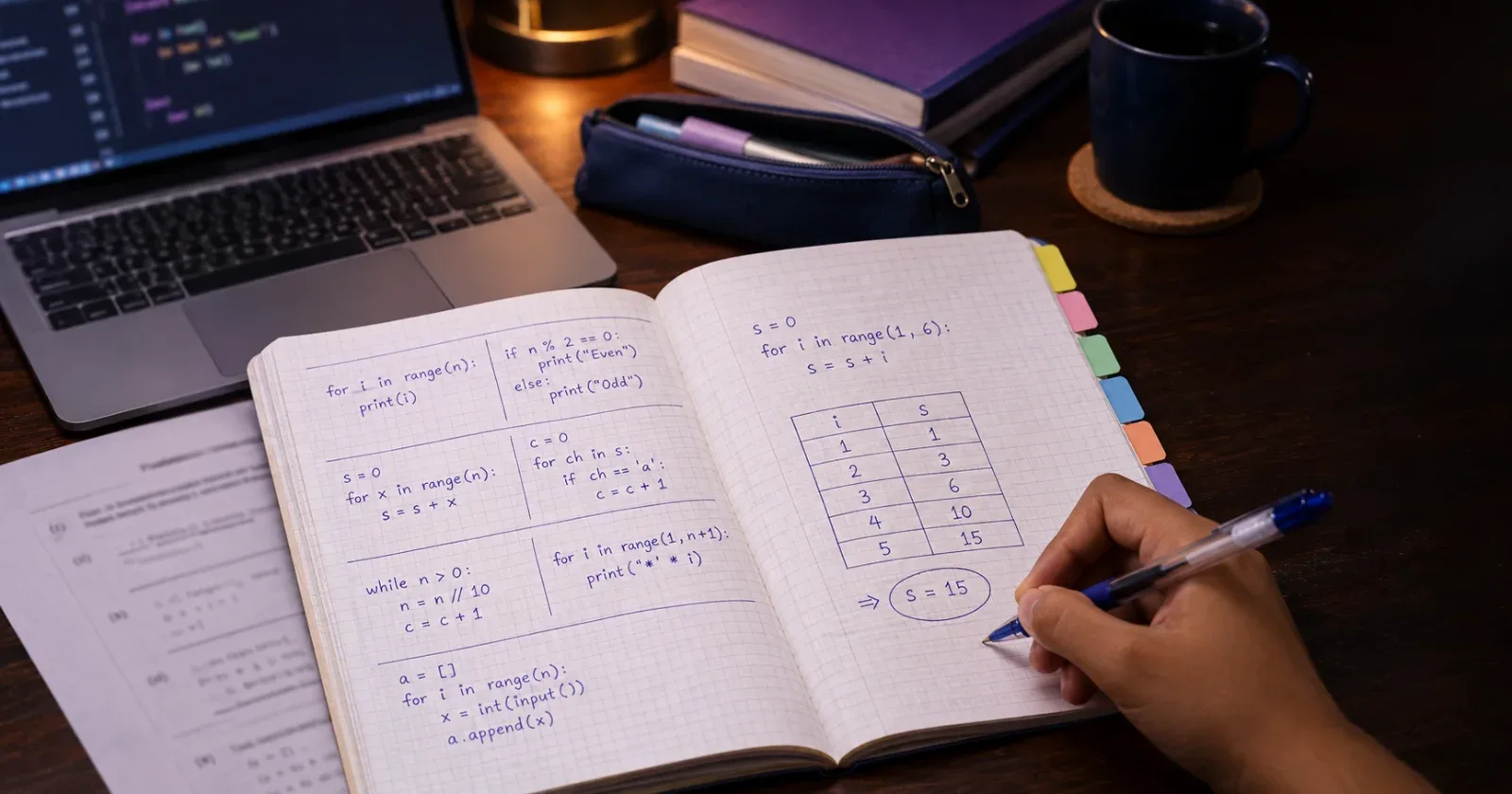
Fix: Trace every loop with a table: one column per variable and one row per iteration. It feels slow, but it is far faster than losing the marks. Revise the programming unit with tracing in mind.
6. Skipping rows in trace tables
In Paper II, trace tables are marked line by line. Students often update only the variable that changes "most" and leave others blank, or skip the final iteration.
Fix: Fill in every variable on every row, even when it does not change. Write the final output clearly below the table.
7. SQL without a WHERE clause
An UPDATE or DELETE without WHERE changes every row in the table. Examiners know this is a common slip and test it. Another frequent error is using WHERE to filter on an aggregate such as COUNT(*); conditions on groups belong in HAVING.
-- Correct: only the student with ID 102 is updated
UPDATE Student SET Grade = 'A' WHERE StudentID = 102;

-- Conditions on groups use HAVING
SELECT ClassID, COUNT(*) FROM Student
GROUP BY ClassID
HAVING COUNT(*) > 30;
Fix: Before you finish any SQL answer, ask: "Which rows does this affect?" Revise the database management unit for the full topic list.
Networking and logic mistakes
8. Confusing addresses with usable hosts in subnetting
A /26 subnet contains 64 addresses, but only 62 can be given to hosts, because the first address identifies the network and the last is the broadcast address.
Fix: Use the rule usable hosts = 2n − 2, where n is the number of host bits. For /26 that is 32 − 26 = 6 host bits, so 26 − 2 = 62.
9. Invalid groups in Karnaugh maps
K-map groups must contain 1, 2, 4, 8 or 16 cells and must be rectangular. Groups of three, or L-shaped groups, are invalid and give the wrong expression. Students also forget that the edges of the map wrap around.
Fix: Make every group as large as possible, use as few groups as possible, and remember that the left and right edges (and top and bottom) are neighbours. Review digital circuits before the exam.
The Paper II mistake that costs the most
10. Poor time and question management
Part B has six essay questions and you must answer four. Students sometimes spend too long on their favourite question, then rush the last one, or start a question they cannot finish.
Fix: Use the ten minutes of reading time to choose your four questions and plan the order. Divide your remaining time fairly between Part A and the four Part B questions, and keep answers structured: short points, labelled diagrams and clear working earn marks more reliably than long paragraphs.
Exam note: Part A is answered on the question paper itself, and the paper states that the space provided is enough. If your answer does not fit, it is probably longer than it needs to be.
Turn A/L ICT exam mistakes into marks
Every mistake on this list can be fixed with deliberate practice. Keep an error log while you do past papers, review it every evening, and these errors will disappear one by one. For worked practice on two of these topics, read our guides to Karnaugh maps and Python code patterns, and download papers from the past papers page.